


Adapt Your CV for Any Career Move in Manchester
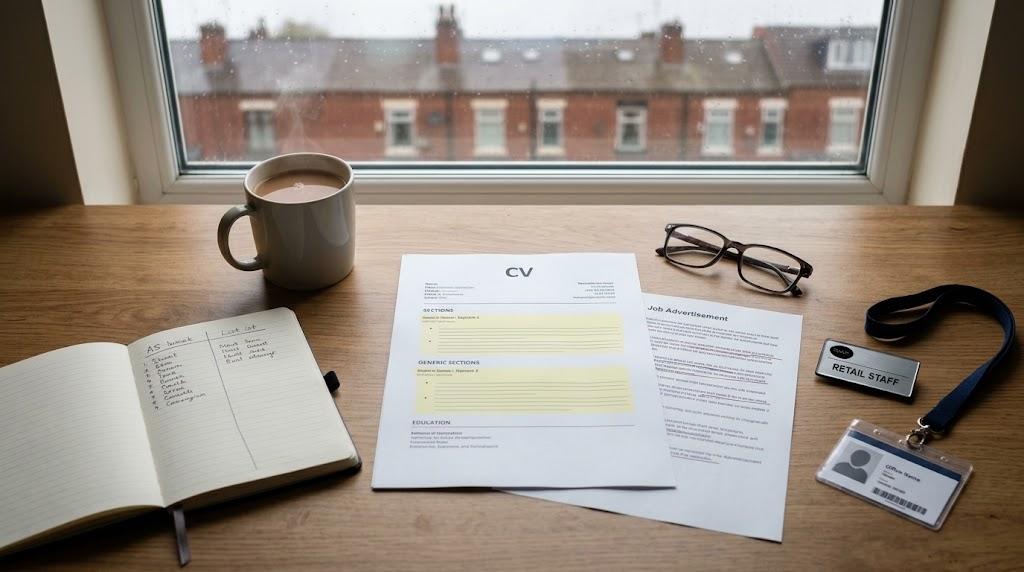
Your CV says retail. The job advert says administration. Somewhere between those two words, a recruiter decides whether to keep reading.
That is the unfair part of changing careers. You know what you can do, but the page only shows where you have been. Your job title gets read. Your skills often do not.
Across Greater Manchester, people make this move every week: retail into admin, hospitality into recruitment, customer service into operations. The jump is usually smaller than it looks. The real task is making the connection visible, fast.
1. Understanding the Topic
Your Job Title Is Hiding Your Best Work
A job title tells an employer where you worked. It says very little about what you can do.
Take a retail supervisor who wants an office role. Their week might include building staff rotas, settling complaints, checking stock records and fixing problems nobody planned for. Half of that is administration in a different uniform.
Recruiters read quickly. If most of your CV talks about tills and shelves, the organisation underneath goes unseen.
Your experience hasn’t lost value. The employer simply needs different evidence to see it.
That said, not every switch is easy. Some professions need qualifications or technical knowledge that clever wording cannot replace. A good CV uses what you have and stays honest about what you haven’t learned yet.
2. Common Problems or Concerns
Three Habits That Quietly Sink Applications
Describing the job as you remember it. “Served customers, operated tills, replenished stock” is true, but thin. Did you handle complaints, keep records or train new starters? Those details matter far more to an admin manager than your till speed.
Leaning on adjectives. “Organised, reliable, excellent communicator” could be written by anyone. Employers trust what you did, not what you call yourself.
Stretching the truth. Helping on a project is not the same as managing it. Interviewers ask follow-up questions, and an inflated line is usually found out within minutes.
Specific evidence beats impressive-sounding claims every time.
3. Key Theories or Concepts to Know
Three ideas do most of the work in a career-change CV.
Transferable skills. These are abilities that carry across jobs, such as prioritising, communicating and solving problems. A supervisor who reshuffles a rota when three people call in sick shows the same skill as an administrator re-planning a diary after a cancellation. Name the skill, then say where you used it.
Competency-based evidence. Employers may assess candidates through examples of their skills and experience. Compare “strong problem-solving skills” with “spotted recurring stock errors and set up checks to find the cause”. The second gives a reader something to believe.
Person–job fit. This is how closely your abilities match what the role demands. A customer service advisor moving into recruitment brings strong conversation skills, but still has to learn screening, software and employment practice. Admitting that gap makes you more credible, not less.
4. Key Factors to Consider
Presentation decisions are where many people get stuck, and some look into an online cv writing service in manchester for help. That can be a sensible step, but any writer still needs your evidence: what you handled, what you improved and what you can honestly claim.
Start with the vacancy, not your existing CV. Read the advert for the work the successful applicant will actually do, then look at your history through that lens.
Explain the Link Between Your Old and New Roles
Career changers usually explain the move in a long profile, or not at all. Either way, the recruiter is left guessing.
Try a single bridge line near the top: what you have done, where you are heading, and the proof that connects them.
“Customer service professional with three years’ experience logging and resolving complaints, now moving into operations after completing an evening course in process improvement.”
One sentence, no apology, no life story. It answers the recruiter’s silent question before they ask it.
Choosing What Goes Where
Give the most space to achievements that match the advert. Shorten duties that do not, and keep job titles and dates exactly as they were.
Numbers help when they are real. A genuine drop in processing time is worth stating. An invented percentage collapses at interview.
Training counts too. A short course shows direction, but present it as a first step, not as equal to years of experience.
5. Practical Guidance
A Quick Translation Exercise
Pick one real vacancy. Not five, one. A CV aimed in every direction convinces nobody.
Draw two columns. On the left, copy the main requirements from the advert. On the right, write a genuine example of when you have met each one, from work, volunteering or a personal project.
Where the right column stays empty, you have found a gap. That is useful, not shameful. It tells you what to study or practise next.
Now sharpen the wording. A retail worker might turn “Responsible for serving customers and operating the till” into “Processed transactions accurately, maintained stock records and coordinated daily tasks during busy trading periods.”
Nothing is invented. Relevant work simply comes into view.
Language matters here too. Manchester’s mix of finance, media, logistics, health and digital employers means terminology varies by sector. A “customer” in one place is a “client” in another and a “patient” in a third, so mirror the wording of the field you are targeting, where it matches what you really did.
Check the layout as well. Many employers use applicant tracking software, and plain headings with a clean structure are usually read more reliably than columns and graphics.
6. Mistakes to Avoid
Changing your official job title. It feels harmless, yet it can read as misleading. Keep the title and let the bullet points do the translating.
Copying phrases from the advert. Writing “stakeholder communication” proves nothing. Describe what you actually did.
Deleting your old industry entirely. Coordinating deliveries across several sites shows planning ability. Strip the context and the achievement goes flat.
Using one CV for every job. Two admin roles can want very different things, one customer-facing, one data-heavy. Adjust the emphasis, never the facts.
7. Bringing the Main Lessons Together
Before you press send, read your CV as a stranger would and ask one question:
Can I find three solid reasons to interview this person for this job?
If you cannot, more adjectives will not help. Clearer evidence will.
Changing industries does not erase your past. It asks you to decide which parts of it matter most for the work ahead.
Start from the employer’s needs, then work backwards through your history for the strongest proof. Be selective, but never distort. Where there is a gap, set out a plan to close it.
Some moves need only a shift in emphasis. Others need training first. Knowing which one you face helps you aim at realistic roles and talk about them with confidence.
Your last job title does not have to match your next one. What matters is showing, honestly and clearly, why your experience belongs in the new role.

 English
 Arabic
 French
 Spanish
 Portuguese
 Deutsch
 Turkish
 Dutch
 Italiano
 Russian
 Portuguese (Brazil)
 Greek