


How to Plan a Nonfiction Book That Holds Together: Tips
You’ve done the research. You’ve collected the stories, the figures and the opinions you earned the hard way. Then a friend reads your first chapters and says, kindly, “It’s interesting... I just got a bit lost.”
That sentence stings, and plenty of authors hear it.
Usually the writing isn’t the problem. You know your subject so well that every connection feels obvious. Your reader only sees one page at a time.
Planning a nonfiction book is mostly deciding what readers need first, what can wait, and what doesn’t belong at all.
Get that right early and the rest gets easier. Get it wrong and you’ll be rebuilding chapters late at night, months into the draft.
1. Start With One Real Reader
Knowing a subject and explaining it in a book are different skills. The first gives you material. The second decides the order it arrives in.
Picture a book for people who’ve just started managing their own money. Someone who has never tracked their spending won’t get much from an investing chapter. They need to see what comes in and goes out first.
Before outlining anything, answer two questions:
- Who is reading, and what do they already know?
- What should they understand, or be able to do, by the last page?
“People interested in business” is too wide. “First-time owners who mix up profit with cash in the bank” is something you can write for.
Your subject decides what you could write. Your reader decides what you should.
2. Why Books Keep Growing
Halfway through research, the book starts to swell. A fascinating study turns up, or a related debate, or a story that would fit nicely.
None of it is unreasonable. But each addition shifts the balance, and the original question gets harder to see.
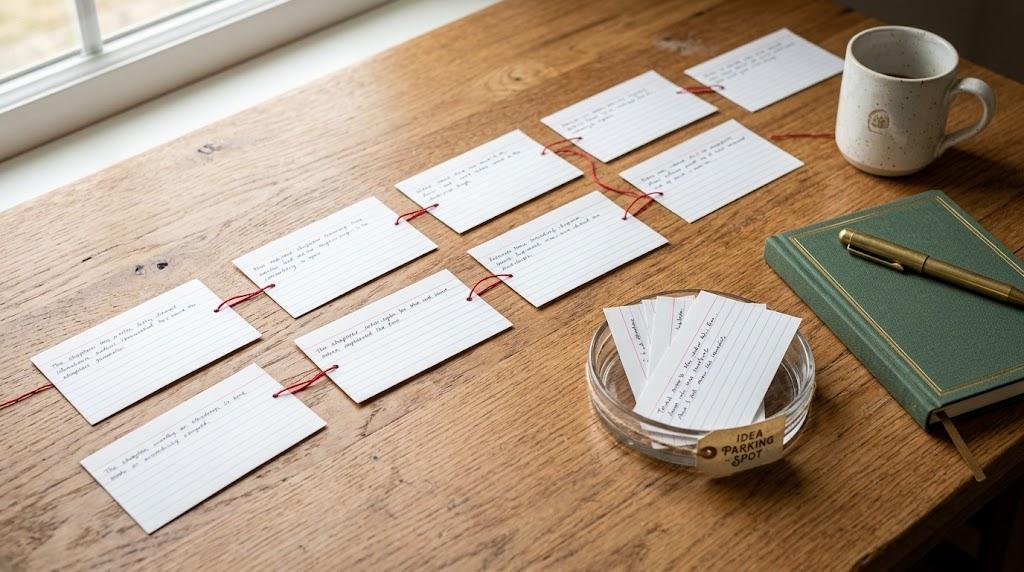
A parking file helps. When something interesting appears, don’t force it in and don’t delete it. Park it, then judge it against the book’s purpose.
Some material needs a decision straight away. Some earns a place later, once the argument has settled. Some is simply the seed of your next book.
The test is simple: does it explain the central argument, answer a likely question, or prepare the reader for what follows?
An editor’s eye can help with these calls. If you’re weighing up a book writing service UK authors often use, check what’s included. Structural editing, line editing and fact-checking are different jobs, and smooth prose doesn’t prove the facts are right.
3. Three Ideas That Make Structure Easier
Audience awareness means respecting where the reader starts. A beginner needs plain English and a worked example. A specialist needs a quick reminder at most.
Logical sequencing is the order ideas arrive in. A practical guide might move from problem to cause to response. A history may run by date, while a book comparing policies over decades may work better by theme.
Chapter unity gives each chapter one job. If two chapters keep making the same argument, merge them. If one carries three unrelated arguments, split it.
4. Scope, Evidence and Examples
Draw a boundary. A book on starting a business can explain cash flow without covering all of tax, employment law and company finance. A boundary tells readers what to expect.
Match evidence to the claim. A personal story can show an experience; it can’t prove that experience is typical. Check what a source actually demonstrates, not what its headline says. Where evidence is thin or disputed, say so.
Choose examples that earn their space. A good example shows how an idea works or where a rule breaks down. If it repeats the last paragraph, cut it.
Check what each chapter assumes. A later section may lean on a term that appeared nowhere earlier. Finding that gap on an outline takes minutes. In a finished manuscript it takes weeks.
5. A Practical Way to Plan
The best outline isn’t the longest. It’s the one that shows what each chapter contributes.
List the questions your reader needs answered, put them in order, then group related ones into chapters. Inventing titles first is riskier, because a title can sound convincing while hiding what the chapter is for.
For each chapter, jot a short note:
- Main question: what does it address?
- Central point: what should the reader understand by the end?
- Supporting material: which sources and examples are needed?
- Connection: why here, rather than earlier or later?
Then try the handover test. Look at the end of each chapter and ask what question it leaves in the reader’s mind. The next chapter should answer it.
A cash-flow chapter might end on a forecast showing a March shortfall. The reader now wants to know what to do, and chapter two delivers exactly that.
If the handover feels forced, the problem may be a weak transition or an unclear relationship between the chapters. Some connect through contrast or chronology rather than cause. That’s fine, as long as you can say why they sit side by side.
Write one representative chapter before drafting the rest. You may find your reader needs more background, or the evidence is thinner than you thought.
6. Mistakes to Avoid
Don’t mistake a long outline for a good one. Twenty headings can say very little.
Don’t treat examples as proof. One business that thrived after changing its prices shows an idea, not a rule.
Don’t polish sentences before fixing structure. Keeping a beautiful passage in the wrong place hurts the chapter.
Don’t assume readers see what you see. If a later argument needs an earlier explanation, say so.
7. Bringing It Together
A nonfiction book holds together when chapters build understanding instead of piling up information. Begin with the reader, give each chapter one job, and test the sequence before you polish the prose.
Before leaving a chapter, ask: what can the reader understand now that they couldn’t before?
If the answer is unclear, the chapter may need a sharper purpose. Or it may need rewriting, merging with another, or cutting altogether.
The aim isn’t to include everything you know. It’s to shape it so someone else can follow.

 English
 Arabic
 Spanish
 Portuguese
 Deutsch
 Turkish
 Dutch
 Italiano
 Russian
 Romaian
 Portuguese (Brazil)
 Greek